Cavities and tooth decay: what's actually happening
Reviewed by a registered dentist · Last reviewed 13 August 2026
Decay is the most common chronic disease on earth, and the most misunderstood. It is not caused by “sweets” so much as by how often your teeth are under acid attack. And it is silent for most of its life — which is precisely the problem.
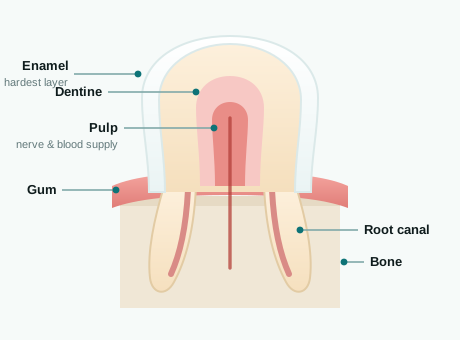
How decay actually happens
Bacteria in dental plaque ferment the sugars and refined carbohydrates you eat and produce acid. That acid pulls minerals out of enamel. Between meals, saliva neutralises the acid and puts minerals back. Decay is simply what happens when demineralisation outpaces repair.
The crucial detail is frequency, not quantity. One dessert eaten in ten minutes causes one acid attack. The same amount of sugar sipped through a cola across three hours causes a near-continuous one. Sweet tea taken six times a day, in the Indian habit, is far more damaging than the same sugar in a single sitting.
The four stages
| Stage | What it looks like | Treatment |
|---|---|---|
| 1. White spot | Chalky white patch, surface still smooth and intact | Reversible — fluoride, better cleaning, less sugar frequency |
| 2. Enamel cavity | A definite hole or catch, still painless | Small filling |
| 3. Dentine decay | Sensitivity to cold and sweet, food packing in, visible dark hole | Larger filling; sometimes a crown |
| 4. Pulp involvement | Lingering or spontaneous pain, night pain, possibly swelling | Root canal treatment, or extraction |
The jump from stage 2 to stage 4 is where the cost multiplies roughly tenfold. Everything about prevention is about not making that jump.
Signs worth acting on
- Food consistently packing into the same gap
- A rough edge or catch you can feel with your tongue
- Fleeting sensitivity to cold or sweet in one specific tooth
- A dark shadow visible through the enamel, especially between teeth
- A tooth that has changed shape, chipped, or feels “soft” when you press it
- Persistent bad breath from one particular spot
Notice that pain is not on this list until quite late. If you are waiting for pain to decide whether to see a dentist, you will consistently arrive at stage 4.
Black spots: cavity or just stain?
Not every dark mark is decay. Tea, coffee, tobacco, iron supplements and certain harmless bacteria all stain enamel black or brown, and that stain is hard, intact and no threat at all. A cavity, by contrast, is soft, catches an explorer probe, often has a greyish shadow spreading beneath it, and tends to sit in a groove or between teeth. Telling them apart reliably needs an examination, and decay between teeth needs an X-ray — it is invisible to the eye until it is large.
What actually prevents decay
Prevention is not one-size-fits-all. The toothpaste strength you need, where you are really missing when you clean, and which of your own habits is doing the damage all depend on your mouth and your risk. In a short video consultation the dentist turns that into a plan built around you — and reviews your brushing, diet pattern and any existing treatment quote at the same time.
Get a prevention plan — book a ₹199 consult
Typical costs in India
| Treatment | Typical private range |
|---|---|
| Consultation with X-ray | ₹200 – ₹800 |
| Composite (tooth-coloured) filling | ₹500 – ₹2,500 |
| Fissure sealant (per tooth) | ₹400 – ₹1,200 |
| Root canal treatment | ₹3,000 – ₹10,000 |
| Crown | ₹3,000 – ₹15,000 |
Indicative only, not a quotation. Government dental colleges charge considerably less. See our medical disclaimer.
Where an online consultation fits
A video consultation is genuinely useful for two things here. First, a second opinion: if you have been handed a plan for six fillings and two root canals, a dentist can look at your X-rays and quotation with you and tell you what is urgent, what is watchful waiting, and what looks like over-treatment. Second, prevention: a proper look at your brushing technique, toothpaste, diet pattern and risk factors takes twenty minutes and can change the next decade of your dental history.
What it cannot do is diagnose decay between teeth — that needs bitewing X-rays — or place the filling.
Been quoted for work you're unsure about?
Get an independent second opinion from a registered dentist for ₹199.
Book a consultationFrequently asked questions
Can a cavity heal on its own?
Only a white-spot lesion, where the enamel has lost minerals but the surface has not broken. Fluoride and reduced sugar frequency can remineralise that. Once there is a physical hole, no toothpaste, oil or diet will close it.
Does oil pulling cure cavities?
No. There is no reliable evidence that oil pulling reverses decay or replaces brushing with fluoride toothpaste. It is harmless as an addition, but relying on it instead of treatment lets decay progress to the nerve.
Are silver fillings unsafe?
Dental amalgam has an extensive safety record and existing amalgam fillings do not need replacing simply because they are amalgam. Most clinics now use tooth-coloured composite by preference for appearance and because it needs less tooth removed.
My filling fell out. Is that an emergency?
Not usually, but see a dentist within a few days. The exposed dentine is sensitive and decays quickly. Keep the area clean, avoid chewing on it, and don't try to glue anything into it.
Related guides
Tooth pain · Tooth sensitivity · Children's dental care · Bleeding gums